
Blog
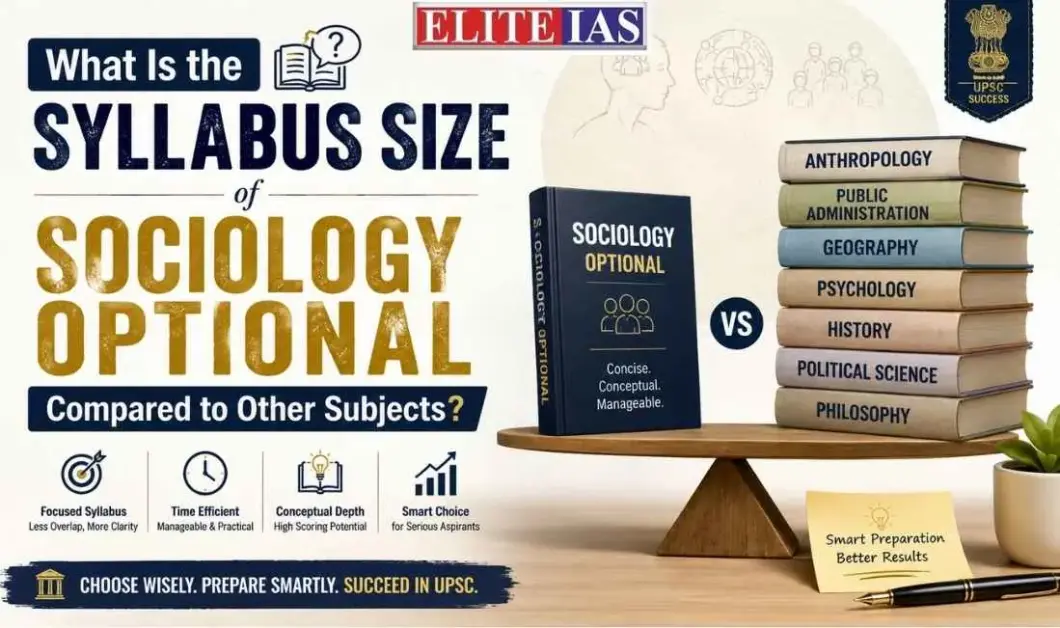
What Is the Syllabus Size of Sociology Optional Compared to Other Subjects?
Choosing an optional subject is one of the most important decisions in the UPSC Civil Services Examination. While factors such as interest, scoring potential, and guidance matter, the size of the syllabus often becomes the deciding factor for many aspirants. A common question that UPSC candidates ask is: Does Sociology Optional really have a smaller syllabus than other popular optional subjects?
The answer is not simply yes or no. Instead, it depends on how you define “small.” A syllabus may look short on paper but require deep conceptual understanding. Conversely, a lengthy syllabus may contain repetitive themes that become easier with practice. Understanding these nuances can help aspirants make an informed decision rather than relying on myths or hearsay.
Many aspirants choose sociology optional coaching because Sociology combines a manageable syllabus with conceptual clarity, excellent overlap with General Studies, and strong answer-writing opportunities. Institutions like Elite IAS have built a reputation for guiding Sociology aspirants under the experienced mentorship of Bibhash Sharma, helping students understand the subject in a structured and exam-oriented manner.
Watch Bibhash Sharma's Teaching Before You Enrol
Sociology Optional – In Reference to UPSC Requirements
Understand what UPSC expects from Sociology Optional and how to prepare in the right direction.
Classroom Teaching Methodology of Bibhash Sharma
Experience the classroom approach that simplifies complex sociological concepts through clear, exam-oriented teaching.
How to Fetch High Marks in Sociology Optional
Learn practical answer-writing and scoring strategies used by successful aspirants.
Why Sociology Students Score High Marks in Essay
Discover how Sociology strengthens analytical thinking and essay performance.
Why Choosing the Right Optional Matters
Your optional subject contributes 500 marks in the UPSC Mains examination, making it one of the biggest score differentiators. Even candidates with excellent General Studies preparation often find that their optional subject determines their final rank.
Therefore, choosing an optional merely because someone calls it “easy” is rarely a wise strategy. Instead, aspirants should evaluate several factors, including:
- Syllabus size
- Conceptual difficulty
- Revision requirements
- Availability of quality study material
- Coaching support
- Interest in the subject
- Time needed for preparation
- Overlap with General Studies and Essay
Among all these parameters, Sociology consistently emerges as one of the most balanced optional subjects.
Is Sociology Optional Really Smaller Than Other UPSC Optionals?
Compared to many traditional UPSC optional subjects, Sociology is generally considered to have a relatively compact and well-defined syllabus. However, “smaller” does not necessarily mean “easier.”
Unlike subjects that require extensive factual memorization, Sociology focuses more on concepts, theories, thinkers, and their practical application to society. Once aspirants understand these concepts, they can apply them across multiple topics instead of memorizing hundreds of isolated facts.
For example, theories proposed by Karl Marx, Max Weber, Emile Durkheim, or M.N. Srinivas appear repeatedly across different themes. This creates natural interlinkages throughout the syllabus, reducing the overall learning burden.
What Makes the Sociology Syllabus Look Smaller?
Several factors contribute to the perception that Sociology has a manageable syllabus.
- Clearly Defined Topics
Unlike subjects with vast historical timelines or detailed geographical processes, Sociology has a structured syllabus divided into two papers:
- Paper I focuses on sociological thinkers, concepts, and theories.
- Paper II applies sociological principles to Indian society.
The boundaries of the syllabus are clearly mentioned, reducing unnecessary reading.
- Strong Conceptual Foundation
Sociology rewards understanding more than rote learning.
Instead of memorizing hundreds of dates or locations, students learn frameworks that can be applied in multiple answers. This makes preparation more efficient and revisions significantly easier.
- Excellent Overlap with General Studies
One of Sociology’s biggest strengths is its overlap with several UPSC papers.
Topics such as:
- Women and society
- Social justice
- Poverty
- Globalization
- Urbanization
- Education
- Tribal issues
- Caste
- Social movements
appear frequently in General Studies Papers I, II, III, and even Essay. This overlap reduces the total preparation time across the UPSC syllabus.
- Mostly Static Content
Unlike subjects that require continuous updates on current developments, a large portion of Sociology remains static.
The theories of classical thinkers, research methods, social institutions, and foundational concepts do not change frequently. Aspirants only need to supplement these concepts with contemporary examples from newspapers and government reports.
This balance between static knowledge and current affairs makes Sociology easier to maintain throughout the preparation cycle.
Comparing Sociology with Other Popular Optional Subjects
Every optional subject has its own strengths and challenges. Comparing syllabus size requires looking beyond the number of topics listed in the UPSC notification.
Sociology vs Geography
Geography is often chosen because of its scientific approach and diagram-based answers. However, the syllabus is considerably broader.
Students need to cover:
- Physical Geography
- Human Geography
- Indian Geography
- Economic Geography
- Environmental Geography
- Geomorphology
- Climatology
- Oceanography
In addition, Geography demands regular map practice and understanding of dynamic environmental developments.
Sociology, by comparison, involves fewer dimensions and offers faster syllabus completion for many candidates.
Sociology vs History
History is one of the largest optional subjects in terms of reading volume.
Aspirants must study:
- Ancient History
- Medieval History
- Modern India
- World History
- Historiography
The sheer amount of factual information makes revision more time-consuming.
Sociology requires conceptual clarity rather than memorizing extensive historical events, making revisions more manageable.
Sociology vs Public Administration
Public Administration was once regarded as one of the shortest optionals. While its syllabus appears concise, the subject has become increasingly dynamic due to governance reforms, administrative theories, and contemporary developments.
Sociology benefits from a more stable theoretical foundation, allowing aspirants to focus on understanding rather than constantly updating notes.
Sociology vs Political Science
Political Science and International Relations offers substantial overlap with General Studies and current affairs. However, international relations, political ideologies, constitutions, and foreign policy require continuous updating.
Sociology involves fewer dynamic components, making long-term revision comparatively easier.
Sociology vs Anthropology
Anthropology has gained popularity because of its scoring potential. Nevertheless, aspirants must study biological anthropology, archaeology, genetics, tribal studies, evolution, and physical anthropology.
Candidates from science backgrounds may find these sections comfortable, but humanities students often require additional effort.
Sociology maintains consistency throughout the syllabus, making it accessible to candidates from engineering, commerce, medicine, and humanities alike.
Sociology vs Philosophy
Philosophy has a compact syllabus on paper. However, abstract philosophical arguments and multiple schools of thought require careful interpretation.
Sociology, on the other hand, deals with real-life social institutions, human behaviour, family, caste, religion, education, and contemporary society. These familiar topics often make learning more engaging and relatable.
Syllabus Size Should Not Be Judged Only by Page Count
Many aspirants make the mistake of comparing optional subjects based solely on the number of pages in the UPSC notification. This approach can be misleading.
A shorter syllabus does not automatically translate into less effort, just as a longer syllabus does not always require proportionately more preparation time. Factors such as conceptual depth, availability of quality study material, revision frequency, answer-writing practice, and the ability to connect topics across papers play an equally important role.
Sociology stands out because many of its concepts reinforce one another, reducing the need to study every topic in isolation. This interconnected nature of the subject allows aspirants to build stronger analytical skills while gradually shortening revision time.
In the next section, we will explore how long Sociology actually takes to complete, whether it is easier to revise than other optionals, who should choose it, and practical strategies that can help aspirants maximize their scores with efficient preparation.
How Much Time Does Sociology Actually Take to Finish?
One of the biggest reasons behind the popularity of Sociology Optional is that many aspirants can complete the subject faster than several other optionals. While preparation time varies according to an individual’s background, consistency, and study hours, most serious candidates complete the first reading in about three to four months with a disciplined approach.
The key advantage lies in the logical flow of the subject. Once you understand fundamental sociological theories, many later topics become easier to grasp because the same concepts reappear in different contexts. This interconnected nature reduces the burden of learning entirely new ideas every week.
Planning the sociology optional syllabus into weekly and monthly targets further improves consistency. Instead of rushing through topics, aspirants should divide the syllabus into manageable sections, allowing sufficient time for revision and answer writing.
Is Sociology Easier to Revise Than Other Optionals?
Revision is where Sociology truly stands out. Since much of the subject revolves around concepts rather than isolated facts, repeated revisions become quicker with each cycle.
Unlike subjects requiring the memorization of numerous dates, locations, or scientific classifications, Sociology emphasizes understanding relationships between ideas. Mind maps, flowcharts, thinker summaries, and keyword-based notes can significantly reduce revision time.
Additionally, contemporary examples from newspapers can be updated periodically without rewriting the entire set of notes. This makes Sociology a sustainable optional even during the final months before the examination.
How Sociology Helps in GS, Essay and Interview
A major strength of Sociology Optional is its significant overlap with multiple stages of the Civil Services Examination.
Topics related to women, caste, poverty, social justice, education, urbanization, globalization, migration, tribal issues, and social change frequently appear in General Studies Papers I and II. Several themes also contribute to ethics case studies and essay writing.
The interview stage also benefits from sociological thinking. Candidates develop the ability to analyse social issues from multiple perspectives instead of giving one-dimensional answers. This balanced approach often creates a positive impression during the personality test.
Biggest Advantages of Choosing Sociology Optional
Sociology offers several practical advantages that make it attractive to UPSC aspirants:
- Well-defined and structured syllabus.
- Strong overlap with General Studies and Essay.
- Concept-based preparation rather than excessive factual memorization.
- Abundant study material and standard reference books.
- Suitable for candidates from science, engineering, commerce, and humanities backgrounds.
- Easier integration of current affairs into answers.
- Faster revision cycles.
- High potential for analytical and balanced answer writing.
For aspirants seeking an optional that combines academic depth with practical utility, Sociology presents a compelling choice.
Challenges Students Should Know Before Choosing Sociology
Although Sociology has many strengths, it is not a shortcut to success.
Some candidates underestimate the subject because they assume social issues are common knowledge. However, UPSC expects academic precision, proper sociological terminology, references to thinkers, and well-structured arguments.
Another challenge is answer writing. Reading theories alone is insufficient unless candidates learn how to apply them to contemporary issues using relevant examples and scholarly perspectives.
Therefore, serious preparation remains essential.
Who Should Choose Sociology Optional?
Sociology is particularly suitable for:
- Beginners entering UPSC preparation.
- Working professionals with limited study time.
- Candidates looking for General Studies overlap.
- Aspirants who enjoy understanding society and human behaviour.
- Students comfortable with analytical writing.
- Candidates seeking an optional with balanced preparation demands.
However, the best optional is always one that aligns with your genuine interest and aptitude. Choosing Sociology only because someone else scored well may not produce the desired outcome.
Practical Preparation Strategy
An effective Sociology preparation strategy follows a systematic sequence.
Begin by thoroughly understanding the UPSC syllabus and previous years’ question papers. Study standard books before moving to coaching notes or supplementary material. Prepare concise notes after every topic and continuously connect theories with current social developments.
Many successful candidates also benefit from expert guidance. At Elite IAS, Sociology aspirants receive structured academic support under the guidance of mentor Bibhash Sharma, helping them develop conceptual clarity alongside effective examination strategies.
Consistency matters far more than studying for long hours occasionally. Even two to three focused hours daily can produce excellent results over time.
Importance of Mock Tests and Answer Writing Practice
Knowledge alone does not guarantee high marks. Presentation plays an equally important role.
Regular answer-writing practice helps aspirants improve structure, time management, analytical thinking, and the use of sociological terminology.
Joining a quality sociology optional test series allows candidates to receive expert feedback, identify weak areas, and gradually improve answer quality. Mock tests also familiarize aspirants with UPSC’s demand for balanced arguments, relevant examples, and logical organization.
The earlier candidates begin answer writing, the greater their confidence on examination day.
Importance of Revision
Revision transforms information into long-term memory.
Instead of repeatedly reading bulky books, aspirants should revise concise notes, thinker charts, diagrams, and previous answers. A planned revision schedule ensures that every topic remains fresh until the examination.
Completing the sociology optional syllabus at least once before beginning intensive revision provides sufficient time for multiple revision cycles. Most toppers recommend revising the entire optional at least three to four times before UPSC Mains.
Common Mistakes Aspirants Make
Many students reduce their scores because of avoidable mistakes, including:
- Ignoring previous years’ questions.
- Memorizing without understanding concepts.
- Neglecting answer writing practice.
- Using generic examples instead of sociological illustrations.
- Failing to quote important thinkers.
- Depending on too many study resources.
- Skipping regular revision.
- Treating current affairs separately instead of integrating them into answers.
Avoiding these mistakes often creates a noticeable improvement in overall performance.
Expert Tips to Finish Sociology Faster
If your goal is to complete Sociology efficiently without compromising quality, consider these practical suggestions:
- Finish one standard source before collecting additional material.
- Prepare topic-wise short notes from the beginning.
- Revise every week instead of waiting until completion.
- Link current affairs with theoretical concepts.
- Practice at least two answers daily after completing each major topic.
- Use diagrams, flowcharts, and thinker quotations wherever relevant.
- Solve previous years’ questions regularly.
- Participate in discussions and peer reviews to strengthen conceptual understanding.
Following a disciplined routine is far more effective than studying randomly for extended hours.
Sociology Optional vs Other Popular Optionals
| Parameter | Sociology | Geography | History | Political Science | Anthropology | Philosophy |
|---|---|---|---|---|---|---|
| Syllabus Size | Relatively Compact | Large | Very Large | Moderate to Large | Moderate | Compact |
| Revision | Easier | Moderate | Time-Consuming | Moderate | Moderate | Moderate |
| GS Overlap | Excellent | High | High | Excellent | Moderate | Limited |
| Answer Writing | Conceptual & Analytical | Analytical | Factual & Analytical | Analytical | Scientific & Analytical | Abstract |
| Preparation Time | Comparatively Shorter | Longer | Longer | Moderate | Moderate | Moderate |
Conclusion
Sociology has earned its reputation as one of the most manageable UPSC optional subjects not because it is “easy,” but because it offers an excellent balance of syllabus size, conceptual clarity, General Studies overlap, and efficient revision. Its structured approach enables aspirants to build analytical thinking while simultaneously strengthening performance in multiple papers of the Civil Services Examination.
At the same time, success in Sociology depends on disciplined preparation, consistent revision, quality answer writing, and proper guidance. Aspirants should avoid selecting any optional solely based on popular opinion or perceived syllabus size. Instead, evaluate your interests, learning style, available resources, and long-term preparation strategy.
If Sociology genuinely aligns with your aptitude, it can become a rewarding optional that supports your overall UPSC journey. With thoughtful planning, continuous practice, and the right mentorship, you can transform this subject into one of your strongest scoring areas and move confidently toward your goal of becoming a civil servant.
Author: Bibhash Sharma
(Senior Sociology Mentor | Elite IAS)
This article is written by Bibhash Sharma, a senior Sociology mentor with 22+ years of experience in UPSC preparation. He specialise in UPSC Sociology Optional. Known for his scientific teaching methodology and result-oriented approach, he has consistently guided aspirants to score 300+ marks in Sociology. His expertise lies in simplifying complex thinkers like Durkheim, Weber, and Marx into structured, exam-ready frameworks.
Through his mentorship at Elite IAS, he has helped hundreds of students build strong conceptual clarity, answer-writing skills, and rank-winning strategies in UPSC CSE.
👉 Explore more about Bibhash Sharma Sociology Optional Classes and Sociology Optional Test Series at Elite IAS.