
Blog
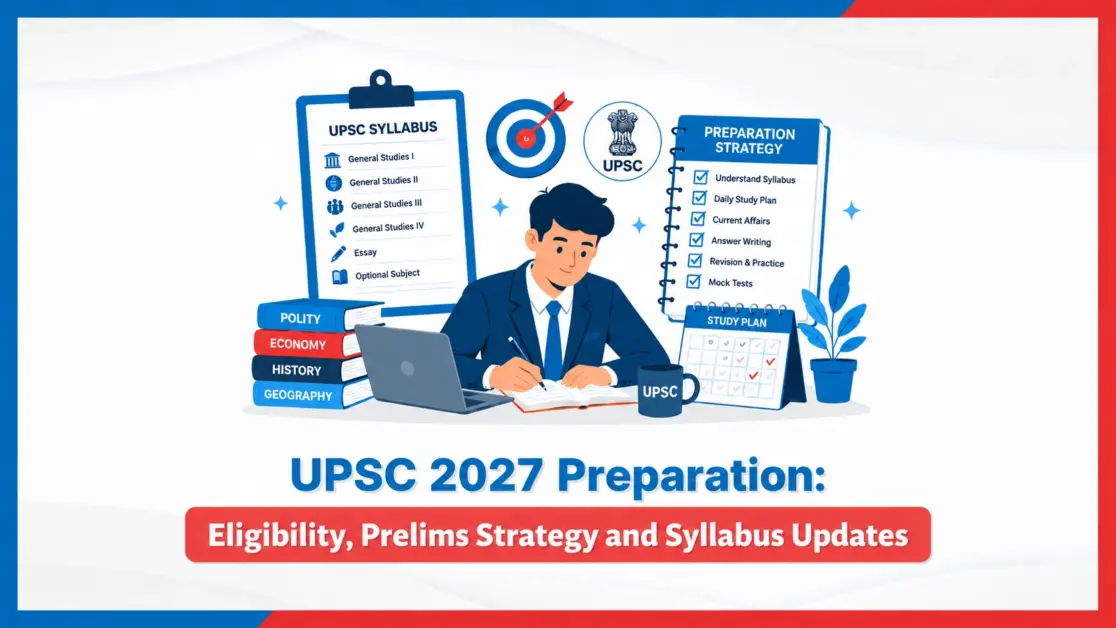
UPSC 2027 Preparation: Eligibility, Prelims Strategy and Syllabus Updates
UPSC CSE 2027 consists of a 3-stage selection process: Preliminary, Mains, and Interview. The Preliminary Exam is the most difficult stage as it eliminates the most candidates; of the 6 lakh+ candidates, only approximately 14,000 will qualify for Mains. To be eligible to take the Civil Services Exam, you must be between the ages of 21 to 32 years old (with an allowance for the different categories: OBC, SC/ST, PwD) and have enough attempts left based on the category you fall under. According to the updated UPSC exam pattern 2027, the Preliminary Exam consists of two separate papers: General Studies Paper I and CSAT (Paper II). From here, those who qualify for Mains will take 9 descriptive papers followed by the Personality Test (Interview).
Considering this, if you are the one targeting UPSC CSE 2027, now is exactly the right time to begin. The Civil Services Examination is one of the reputed and demanding competitive exams in India, where the aspirant needs to keep a tab on current affairs, build a strong foundation in core subjects such as History, Polity, Geography, develop analytical & answer-writing skills, and maintain consistency throughout the learning journey. But before that, an overview of eligibility, Prelims strategy, syllabus updates, and more- something which is significant. Here’s a breakdown of everything that you need to know before you begin your UPSC 2027 preparation.
UPSC 2027 Eligibility
Keeping in mind the basic Civil Services eligibility requirements set by the Union Public Service Commission, candidates must ensure that they satisfy all the criteria related to nationality, age limit, educational qualification, and the number of attempts before applying for the examination.
Nationality: Indian citizens are eligible. Candidates from Nepal, Bhutan, and certain categories of migrants from Pakistan, Sri Lanka, and East African countries may also be eligible under specific conditions as per UPSC norms.
Educational Qualification: You must hold a graduation degree from a recognized university. Final-year degree students can also apply — you will need to produce proof of passing at the time of the interview. There is no minimum percentage requirement.
Age Limit:
- General category: 21 to 32 years
- OBC: 21 to 35 years (3 years relaxation)
- SC/ST: 21 to 37 years (5 years relaxation)
- PwBD candidates: Additional relaxation as per UPSC rules
Number of Attempts:
- General: 6 attempts
- OBC: 9 attempts
- SC/ST: Unlimited attempts (until age limit)
In the UPSC Civil Services Exam 2027, these criteria are consistent year on year, but always verify directly from the official UPSC notification released at the start of the year.
UPSC Exam Pattern 2027
UPSC CSE is a three-stage examination:
Preliminary Examination (Prelims) — Objective, screening stage
Main Examination (Mains) — Descriptive, merit-determining stage
Personality Test (Interview) — Final stage
Prelims consists of two papers: GS Paper I (200 marks, 100 questions) and CSAT Paper II (200 marks, 80 questions). It is the GS Paper I marks that are counted for merit, while CSAT is qualifying in nature with a 33% cutoff. Pay equal attention to CSAT by picking the best CSAT books, such as those of Oswaal that offer you extensive practice questions, previous years’ papers, and exam-oriented exercises, which can help strengthen aptitude, reasoning, and comprehension skills.
UPSC Syllabus 2027: What You Need to Know
You may not find a structural overhaul in the UPSC syllabus, but the nature of questions has significantly evolved for sure. Let’s have a look at the topics that are included in the Prelims GS Paper I:
- Current Events of national and international importance
- History of India and the Indian National Movement
- Indian and World Geography — physical, social, and economic
- Indian Polity and Governance — Constitution, political system, panchayati raj, public policy
- Economic and Social Development — sustainable development, poverty, inclusion, demographics
- General Issues on Environmental Ecology, Biodiversity and Climate Change
- General Science
A key trend in recent UPSC Prelims papers is the shift toward application-based and elimination-type questions rather than direct factual recall. The examiner is not testing whether you have memorised a fact; they are testing whether you understand it well enough to eliminate wrong options intelligently.
Prelims Strategy for UPSC 2027
UPSC Prelims is all about memorising as many facts as you can, and performing exceptionally under time pressure and negative marking. With roughly a year ahead of you for the 2027 cycle, here’s a strategy that actually holds up.
Begin with Class 6-12 NCERTs (History, Geography, Polity, Economics, Science) that give you a conceptual base. To have more clarity and ease in preparation, you can stick to Oswaal NCERT One For All, where you can expect the important topics from both NCERT editions (Old + New), extensive practice questions, and easy-to-read NCERT summaries.
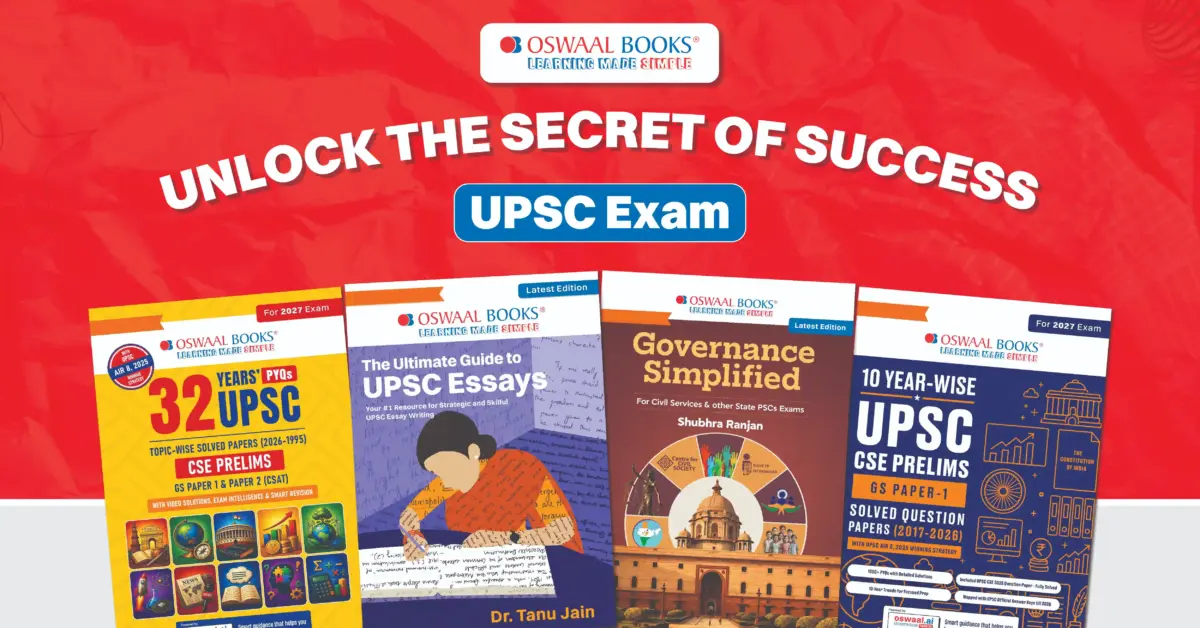
Create a core book list of texts that you want to read throughout the entire preparation process, and stick to it. Choose one reference text for each subject — for Polity (Laxmikanth), Modern History (Spectrum or Bipan Chandra), Geography (NCERT’s plus G.C. Leong for physical geography), Economy (Ramesh Singh or notes based on NCERT), and Science & Tech (basic compilation). Use Oswaal’s 32 Years UPSC CSE Prelims Topic-wise Solved Papers instead of changing books so that you have access to expert video solutions, tagging question types (direct, analytical & elimination), theme-based analysis, source links, mentoring tips, and solved papers from 2026.
Current affairs need to be prepared well. Read one newspaper daily (The Hindu or Indian Express), but the real value comes from monthly compilation and revision, not just reading. Make short notes as you go rather than trying to revise a year’s worth of newspaper clippings in the last month.
Answer at least 15,000–20,000 MCQs before the exam, from Oswaal UPSC Previous Years Question Papers For 2027, along with full-length mock tests. PYQs matter more than people initially appreciate; they reveal exactly how UPSC frames questions and which areas it returns to repeatedly.
It is important to remember that the last 4-5 months before your exam need to be spent taking mock tests that cannot be argued with. This is where most students are set apart from their competition. This is not just about getting good marks, but how to decide which questions to do, how to manage the time limit of 2 hours, and how to become comfortable with elimination techniques instead of just using memory to answer every question.
Do not neglect studying for the CSAT. You need to pass (33%), but so many students fail their Prelims every year due to being too confident in this part of the test. Regular practice, especially with reading comprehension and basic math/logic, will help avoid the unpleasant surprise you would get during your Prelims.
Revision cycles matter more than first reads. Plan for at least 3 full revisions of your core material before the exam: first read for understanding, second for consolidation, third for speed and recall under time pressure.
It always seems impossible until it’s done — Nelson Mandela
With this beautiful quote, the message is simple: Each of those Prelims toppers began their journey at the same syllabus that you are currently looking at, and they too experienced the same feelings of doubt about their ability to finish the Civil Services Exam in the same amount of time as you have currently planned for. By fully understanding the exam eligibility and pattern, as well as what to expect from the exam syllabus, can facilitate a smoother and less stressful path towards achieving success in this examination.
Once you have established a good understanding of the UPSC and all that it entails, put in your best effort and utilise only the very best and most reputable study materials, such as Oswaal UPSC preparation books, to gain a greater understanding of the exam format, weightage of subjects, to learn the underlying principles of your study material and to develop sound foundation for your studies through answering sample questions that are exam related. By combining effective study materials with a consistent revision effort and taking mock tests during your preparation, your overall study preparation will become much more focused, organised and effective.
Work hard, be consistent, pat your back for even the small wins, believe in yourself and let the universe do the rest. Because the truth is, no one can predict the exact day your hard work will yield results, but if you keep showing up, that day will come…Good Luck!
FAQs
Q1. Can I start UPSC 2027 preparation from scratch right now?
Absolutely. With limited time in hand, a disciplined aspirant starting today has sufficient time to cover the full syllabus, analyse PYQs, attempt mocks, and revise thoroughly before the 2027 Prelims.
Q2. Is graduation mandatory to apply for UPSC CSE 2027?
Yes, a graduation degree from a recognised university is mandatory. However, final-year students can also apply provisionally and submit proof of passing later.
Q3. How many attempts do I get for UPSC CSE?
General category candidates get 6 attempts up to age 32. OBC candidates get 9 attempts up to age 35. SC/ST candidates have unlimited attempts within the age limit of 37 years.
Q4. Has the UPSC Prelims syllabus changed for 2027?
No official structural change has been announced. However, question trends evolve every year. Analysing 30+ years of PYQs helps aspirants stay ahead of these shifts.
Q5. Why are previous year questions so important for UPSC Prelims?
UPSC frequently revisits themes, concepts, and even specific facts from earlier papers. Chapter-wise PYQ books like Oswaal’s 32 Years UPSC CSE Prelims help you decode these patterns topic by topic, making your revision both targeted and efficient.
Q6. Should I join coaching for UPSC 2027?
Coaching is beneficial for structure and guidance but not mandatory. Many successful candidates are self-taught. The key is following the right resources, analyzing PYQs consistently, and maintaining mock test discipline.